
















Occupational Therapist
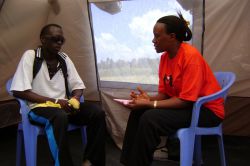
Occupational Therapists work with people who are physically or mentally disabled and those suffering from chronic illnesses. They use activities as a mean of rehabilitating such people to full independence. An occupational Therapist works in hospital settings in the community, and in psychiatric services. Upon completion of the course, they are employed in Government or Non-Government Hospitals and Factories. (Info: Ministry of Education, Science, Technology and Sports, Career Guidance Handbook)
Occupational Therapist
Occupational Therapist
Assess, plan, organize, and participate in rehabilitative programs that help build or restore vocational, homemaking, and daily living skills, as well as general independence, to persons with disabilities or developmental delays.
Sample of reported job titles: Assistive Technology Trainer, Early Intervention Occupational Therapist, Industrial Rehabilitation Consultant, Occupational Therapist (OT), Occupational Therapy Co-Director, Pediatric Occupational Therapist, Registered Occupational Therapist, Rehabilitation Supervisor, Staff Occupational Therapist, Staff Therapist
Daily/Routine Tasks
- 1.Test and evaluate patients' physical and mental abilities and analyze medical data to determine realistic rehabilitation goals for patients.
- 2.Train caregivers how to provide for the needs of a patient during and after therapy.
- 3.Evaluate patients' progress and prepare reports that detail progress.
- 4.Plan, organize, and conduct occupational therapy programs in hospital, institutional, or community settings to help rehabilitate those impaired because of illness, injury or psychological or developmental problems.
- 5.Select activities that will help individuals learn work and life-management skills within limits of their mental or physical capabilities.
- 6.Design and create, or requisition, special supplies and equipment, such as splints, braces, and computer-aided adaptive equipment.
- 7.Consult with rehabilitation team to select activity programs or coordinate occupational therapy with other therapeutic activities.
- 8.Lay out materials such as puzzles, scissors and eating utensils for use in therapy, and clean and repair these tools after therapy sessions.
- 9.Plan and implement programs and social activities to help patients learn work or school skills and adjust to handicaps.
- 10.Help clients improve decision making, abstract reasoning, memory, sequencing, coordination, and perceptual skills, using computer programs.
- 11.Provide training and supervision in therapy techniques and objectives for students or nurses and other medical staff.
- 12.Conduct research in occupational therapy.
Key Knowledge Areas
- Psychology — Knowledge of human behavior and performance; individual differences in ability, personality, and interests; learning and motivation; psychological research methods; and the assessment and treatment of behavioral and affective disorders.
- Therapy and Counseling — Knowledge of principles, methods, and procedures for diagnosis, treatment, and rehabilitation of physical and mental dysfunctions, and for career counseling and guidance.
- Medicine and Dentistry — Knowledge of the information and techniques needed to diagnose and treat human injuries, diseases, and deformities. This includes symptoms, treatment alternatives, drug properties and interactions, and preventive health-care measures.
- Education and Training — Knowledge of principles and methods for curriculum and training design, teaching and instruction for individuals and groups, and the measurement of training effects.
- English Language — Knowledge of the structure and content of the English language including the meaning and spelling of words, rules of composition, and grammar.
- Sociology and Anthropology — Knowledge of group behavior and dynamics, societal trends and influences, human migrations, ethnicity, cultures and their history and origins.
- Customer and Personal Service — Knowledge of principles and processes for providing customer and personal services. This includes customer needs assessment, meeting quality standards for services, and evaluation of customer satisfaction.
- Biology — Knowledge of plant and animal organisms, their tissues, cells, functions, interdependencies, and interactions with each other and the environment.
Skills Needed
- Monitoring — Monitoring/Assessing performance of yourself, other individuals, or organizations to make improvements or take corrective action.
- Service Orientation — Actively looking for ways to help people.
- Active Listening — Giving full attention to what other people are saying, taking time to understand the points being made, asking questions as appropriate, and not interrupting at inappropriate times.
- Critical Thinking — Using logic and reasoning to identify the strengths and weaknesses of alternative solutions, conclusions or approaches to problems.
- Judgment and Decision Making — Considering the relative costs and benefits of potential actions to choose the most appropriate one.
Career Interests
Interest code: SI
- Social — Social occupations frequently involve working with, communicating with, and teaching people. These occupations often involve helping or providing service to others.
- Investigative — Investigative occupations frequently involve working with ideas, and require an extensive amount of thinking. These occupations can involve searching for facts and figuring out problems mentally.
Work Styles
- Integrity — Job requires being honest and ethical.
- Adaptability/Flexibility — Job requires being open to change (positive or negative) and to considerable variety in the workplace.
- Concern for others — Job requires being sensitive to others' needs and feelings and being understanding and helpful on the job.
- Dependability — Job requires being reliable, responsible, and dependable, and fulfilling obligations.
- Self-Control — Job requires maintaining composure, keeping emotions in check, controlling anger, and avoiding aggressive behavior, even in very difficult situations.
Work Values
- Relationships — Occupations that satisfy this work value allow employees to provide service to others and work with co-workers in a friendly non-competitive environment. Corresponding needs are Co-workers, Moral Values and Social Service.
- Achievement — Occupations that satisfy this work value are results oriented and allow employees to use their strongest abilities, giving them a feeling of accomplishment. Corresponding needs are Ability Utilization and Achievement.
- Working Conditions — Occupations that satisfy this work value offer job security and good working conditions. Corresponding needs are Activity, Compensation, Independence, Security, Variety and Working Conditions.
Some of the courses that prepare students for this career
-
Apprenticeship is the proven way for getting excellent workers
Know more -
How to choose the right career path
Know more -
How to draw career inspiration from what you learn in class
Know more -
why you cannot give up now
Know more -
Know more -
Know more -
Know more -
 The 10,000 hours of practice
Know more -
Know more -
Know more -
Know more -
Know more -
Know more -
Valuing today as you visualize tomorrow
Know more -
Jack Ma tells it all
Know more -
Joint courses give graduates edge
Know more -
Sports can boost your confidence
Know more -
 There are more than three job opportunities in a given profession that one can take advantage of.
Know more -
Know more
Watch and Listen what the practioneers in your field are saying