
















Audiologist
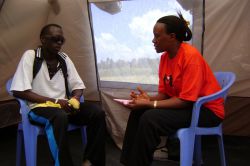
Assess and treat persons with hearing and related disorders. May fit hearing aids and provide auditory training. May perform research related to hearing problems.
Audiologist
Daily tasks/Routine activities
1. Examine patients who have hearing, balance, or related ear problems
2. Assess the results of the examination and diagnose problems
3. Determine and administer treatment to meet patients’ goals
4. Provide treatment for tinnitus, a condition that causes ringing in the ear
5. Fit and dispense hearing aids
6. Counsel patients and their families on ways to listen and communicate, such as by lip reading or through technology
7. Evaluate patients regularly to check on hearing and balance and to continue or change the treatment plan
8. Record patient progress
9. Research the causes and treatment of hearing and balance disorders
10. Educate patients on ways to prevent hearing loss
Key Knowledge Areas
Customer and Personal Service — Knowledge of principles and processes for providing customer and personal services. This includes customer needs assessment, meeting quality standards for services, and evaluation of customer satisfaction.
English Language — Knowledge of the structure and content of the English language including the meaning and spelling of words, rules of composition, and grammar.
Therapy and Counseling — Knowledge of principles, methods, and procedures for diagnosis, treatment, and rehabilitation of physical and mental dysfunctions, and for career counseling and guidance.
Psychology — Knowledge of human behavior and performance; individual differences in ability, personality, and interests; learning and motivation; psychological research methods; and the assessment and treatment of behavioral and affective disorders.
Medicine and Dentistry — Knowledge of the information and techniques needed to diagnose and treat human injuries, diseases, and deformities. This includes symptoms, treatment alternatives, drug properties and interactions, and preventive health-care measures.
Sales and Marketing — Knowledge of principles and methods for showing, promoting, and selling products or services. This includes marketing strategy and tactics, product demonstration, sales techniques, and sales control systems.
Computers and Electronics — Knowledge of circuit boards, processors, chips, electronic equipment, and computer hardware and software, including applications and programming.
Biology — Knowledge of plant and animal organisms, their tissues, cells, functions, interdependencies, and interactions with each other and the environment.
Administration and Management — Knowledge of business and management principles involved in strategic planning, resource allocation, human resources modeling, leadership technique, production methods, and coordination of people and resources.
Skills
Active Listening — Giving full attention to what other people are saying, taking time to understand the points being made, asking questions as appropriate, and not interrupting at inappropriate times.
Critical Thinking — Using logic and reasoning to identify the strengths and weaknesses of alternative solutions, conclusions or approaches to problems.
Speaking — Talking to others to convey information effectively.
Active Learning — Understanding the implications of new information for both current and future problem-solving and decision-making.
Monitoring — Monitoring/Assessing performance of yourself, other individuals, or organizations to make improvements or take corrective action.
Social Perceptiveness — Being aware of others' reactions and understanding why they react as they do.
Writing — Communicating effectively in writing as appropriate for the needs of the audience.
Judgment and Decision Making — Considering the relative costs and benefits of potential actions to choose the most appropriate one.
Complex Problem Solving — Identifying complex problems and reviewing related information to develop and evaluate options and implement solutions.
Abilities
Communication skills: Audiologists need to communicate test results, diagnoses, and proposed treatments, so patients clearly understand the situation and options. They also may need to work on teams with other healthcare providers and education specialists regarding patient care.
Compassion: Audiologists work with patients who may be frustrated or emotional because of their hearing or balance problems. Audiologists should be empathetic and supportive of patients and their families.
Critical-thinking skills: Audiologists must concentrate when testing a patient’s hearing and be able to analyze each patient’s situation, to offer the best treatment. They must also be able to provide alternative plans when patients do not respond to initial treatment.
Patience: Audiologists must work with patients who may need a lot of time and special attention.
Problem-solving skills: Audiologists must figure out the causes of problems with hearing and balance and determine the appropriate treatment or treatments to address them.
Interests
Investigative — Investigative occupations frequently involve working with ideas, and require an extensive amount of thinking. These occupations can involve searching for facts and figuring out problems mentally.
Social — Social occupations frequently involve working with, communicating with, and teaching people. These occupations often involve helping or providing service to others.
Some of the courses that prepare students for this career
-
Apprenticeship is the proven way for getting excellent workers
Know more -
How to choose the right career path
Know more -
How to draw career inspiration from what you learn in class
Know more -
why you cannot give up now
Know more -
Know more -
Know more -
Know more -
 The 10,000 hours of practice
Know more -
Know more -
Know more -
Know more -
Know more -
Know more -
Valuing today as you visualize tomorrow
Know more -
Jack Ma tells it all
Know more -
Joint courses give graduates edge
Know more -
Sports can boost your confidence
Know more -
 There are more than three job opportunities in a given profession that one can take advantage of.
Know more -
Know more
Watch and Listen what the practioneers in your field are saying