











Medical Records and Health Information Technician
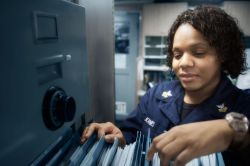
Compile, process, and maintain medical records of hospital and clinic patients in a manner consistent with medical, administrative, ethical, legal, and regulatory requirements of the health care system. Process, maintain, compile, and report patient information for health requirements and standards in a manner consistent with the healthcare industry's numerical coding system.
Medical Records and Health Information Technician
Medical records and health information technicians, commonly referred to as health information technicians, organize and manage health information data by ensuring that it maintains its quality, accuracy, accessibility, and security in both paper files and electronic systems. They use various classification systems to code and categorize patient information for insurance reimbursement purposes, for databases and registries, and to maintain patients’ medical and treatment histories.
Daily Tasks/Routine activities
Health information technicians typically do the following:
1. Review patients’ records for timeliness, completeness, accuracy, and appropriateness of data
2. Organize and maintain data for clinical databases and registries
3. Track patient outcomes for quality assessment
4. Use classification software to assign clinical codes for reimbursement and data analysis
5. Electronically record data for collection, storage, analysis, retrieval, and reporting
6. Maintain confidentiality of patients’ records
Key Knowledge Areas
Clerical — Knowledge of administrative and clerical procedures and systems such as word processing, managing files and records, stenography and transcription, designing forms, and other office procedures and terminology.
English Language — Knowledge of the structure and content of the English language including the meaning and spelling of words, rules of composition, and grammar.
Computers and Electronics — Knowledge of circuit boards, processors, chips, electronic equipment, and computer hardware and software, including applications and programming.
Customer and Personal Service — Knowledge of principles and processes for providing customer and personal services. This includes customer needs assessment, meeting quality standards for services, and evaluation of customer satisfaction.
Skills
Reading Comprehension — Understanding written sentences and paragraphs in work related documents.
Active Listening — Giving full attention to what other people are saying, taking time to understand the points being made, asking questions as appropriate, and not interrupting at inappropriate times.
Critical Thinking — Using logic and reasoning to identify the strengths and weaknesses of alternative solutions, conclusions or approaches to problems.
Speaking — Talking to others to convey information effectively.
Writing — Communicating effectively in writing as appropriate for the needs of the audience.
Abilities
Near Vision — The ability to see details at close range (within a few feet of the observer).
Oral Comprehension — The ability to listen to and understand information and ideas presented through spoken words and sentences.
Written Comprehension — The ability to read and understand information and ideas presented in writing.
Oral Expression — The ability to communicate information and ideas in speaking so others will understand.
Category Flexibility — The ability to generate or use different sets of rules for combining or grouping things in different ways.
Deductive Reasoning — The ability to apply general rules to specific problems to produce answers that make sense.
Information Ordering — The ability to arrange things or actions in a certain order or pattern according to a specific rule or set of rules (e.g., patterns of numbers, letters, words, pictures, mathematical operations).
Speech Recognition — The ability to identify and understand the speech of another person.
Written Expression — The ability to communicate information and ideas in writing so others will understand.
Interests
Conventional — Conventional occupations frequently involve following set procedures and routines. These occupations can include working with data and details more than with ideas. Usually there is a clear line of authority to follow.
Enterprising — Enterprising occupations frequently involve starting up and carrying out projects. These occupations can involve leading people and making many decisions. Sometimes they require risk taking and often deal with business.
Some of the courses that prepare students for this career
-
Apprenticeship is the proven way for getting excellent workers
Know more -
How to choose the right career path
Know more -
How to draw career inspiration from what you learn in class
Know more -
why you cannot give up now
Know more -
Know more -
Know more -
Know more -
 The 10,000 hours of practice
Know more -
Know more -
Know more -
Know more -
Know more -
Know more -
Valuing today as you visualize tomorrow
Know more -
Jack Ma tells it all
Know more -
Joint courses give graduates edge
Know more -
Sports can boost your confidence
Know more -
 There are more than three job opportunities in a given profession that one can take advantage of.
Know more -
Know more
Watch and Listen what the practioneers in your field are saying