Direct and may participate in the preparation, seasoning, and cooking of salads, soups, fish, meats, vegetables, desserts, or other foods. May plan and price menu items, order supplies, and keep records and accounts.
Chefs and head cooks use a variety of kitchen and cooking equipment, including step-in coolers, high-quality knives, meat slicers, and grinders. They also have access to large quantities of meats, spices, and produce. Some chefs use scheduling and purchasing software to help them in their administrative tasks.
Sample of reported job titles: Banquet Chef; Certified Executive Chef (CEC); Chef; Chef, Instructor; Cook; Corporate Executive Chef; Executive Chef (Ex Chef); Executive Sous Chef; Head Cook; Line Cook
Daily/Routine Tasks
1. Check the freshness of food and ingredients
2. Supervise and coordinate activities of cooks and other food preparation workers
3. Develop recipes and determine how to present dishes
4. Plan menus and ensure the quality of meals
5. Inspect supplies, equipment, and work areas for cleanliness and functionality
6. Hire, train, and supervise cooks and other food preparation workers
7. Order and maintain an inventory of food and supplies
8. Monitor sanitation practices and follow kitchen safety standards
Key Knowledge Areas
Food Production — Knowledge of techniques and equipment for planting, growing, and harvesting food products (both plant and animal) for consumption, including storage/handling techniques. Production and Processing — Knowledge of raw materials, production processes, quality control, costs, and other techniques for maximizing the effective manufacture and distribution of goods. Customer and Personal Service — Knowledge of principles and processes for providing customer and personal services. This includes customer needs assessment, meeting quality standards for services, and evaluation of customer satisfaction. Education and Training — Knowledge of principles and methods for curriculum and training design, teaching and instruction for individuals and groups, and the measurement of training effects. Administration and Management — Knowledge of business and management principles involved in strategic planning, resource allocation, human resources modeling, leadership technique, production methods, and coordination of people and resources. Mathematics — Knowledge of arithmetic, algebra, geometry, calculus, statistics, and their applications. Personnel and Human Resources — Knowledge of principles and procedures for personnel recruitment, selection, training, compensation and benefits, labor relations and negotiation, and personnel information systems. English Language — Knowledge of the structure and content of the English language including the meaning and spelling of words, rules of composition, and grammar. Public Safety and Security — Knowledge of relevant equipment, policies, procedures, and strategies to promote effective local, state, or national security operations for the protection of people, data, property, and institutions.
Skills needed
Monitoring — Monitoring/Assessing performance of yourself, other individuals, or organizations to make improvements or take corrective action.
Coordination — Adjusting actions in relation to others' actions.
Speaking — Talking to others to convey information effectively.
Management of Personnel Resources — Motivating, developing, and directing people as they work, identifying the best people for the job.
Social Perceptiveness — Being aware of others' reactions and understanding why they react as they do.
Time Management — Managing one's own time and the time of others.
Active Listening — Giving full attention to what other people are saying, taking time to understand the points being made, asking questions as appropriate, and not interrupting at inappropriate times.
Critical Thinking — Using logic and reasoning to identify the strengths and weaknesses of alternative solutions, conclusions or approaches to problems.
Judgment and Decision Making — Considering the relative costs and benefits of potential actions to choose the most appropriate one.
Active Learning — Understanding the implications of new information for both current and future problem-solving and decision-making.
Service Orientation — Actively looking for ways to help people.
Instructing — Teaching others how to do something.
Negotiation — Bringing others together and trying to reconcile differences.
Complex Problem Solving — Identifying complex problems and reviewing related information to develop and evaluate options and implement solutions.
Management of Material Resources — Obtaining and seeing to the appropriate use of equipment, facilities, and materials needed to do certain work.
Persuasion — Persuading others to change their minds or behavior.
Quality Control Analysis — Conducting tests and inspections of products, services, or processes to evaluate quality or performance.
Learning Strategies — Selecting and using training/instructional methods and procedures appropriate for the situation when learning or teaching new things.
Management of Financial Resources — Determining how money will be spent to get the work done, and accounting for these expenditures.
Mathematics — Using mathematics to solve problems.
Reading Comprehension — Understanding written sentences and paragraphs in work related documents.
Career Interests
Enterprising — Enterprising occupations frequently involve starting up and carrying out projects. These occupations can involve leading people and making many decisions. Sometimes they require risk taking and often deal with business. Realistic — Realistic occupations frequently involve work activities that include practical, hands-on problems and solutions. They often deal with plants, animals, and real-world materials like wood, tools, and machinery. Many of the occupations require working outside, and do not involve a lot of paperwork or working closely with others. Artistic — Artistic occupations frequently involve working with forms, designs and patterns. They often require self-expression and the work can be done without following a clear set of rules.
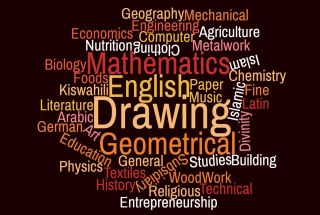
Some of the courses that prepare students for this career